
Heat is the hidden foe of all energy storage setups. In brief, custom-made heatsinks ensure that the batteries remain in their safe temperature zones, thus increasing their lifespan, preventing thermal runaway, and making sure that ESS and BESS systems operate as efficiently as possible.
With the growing use of renewable energy, manufacturers rely on specialized thermal solutions rather than ordinary cooling components. PT Heatsink offers design and fabrication of thermal equipment for energy storage systems.
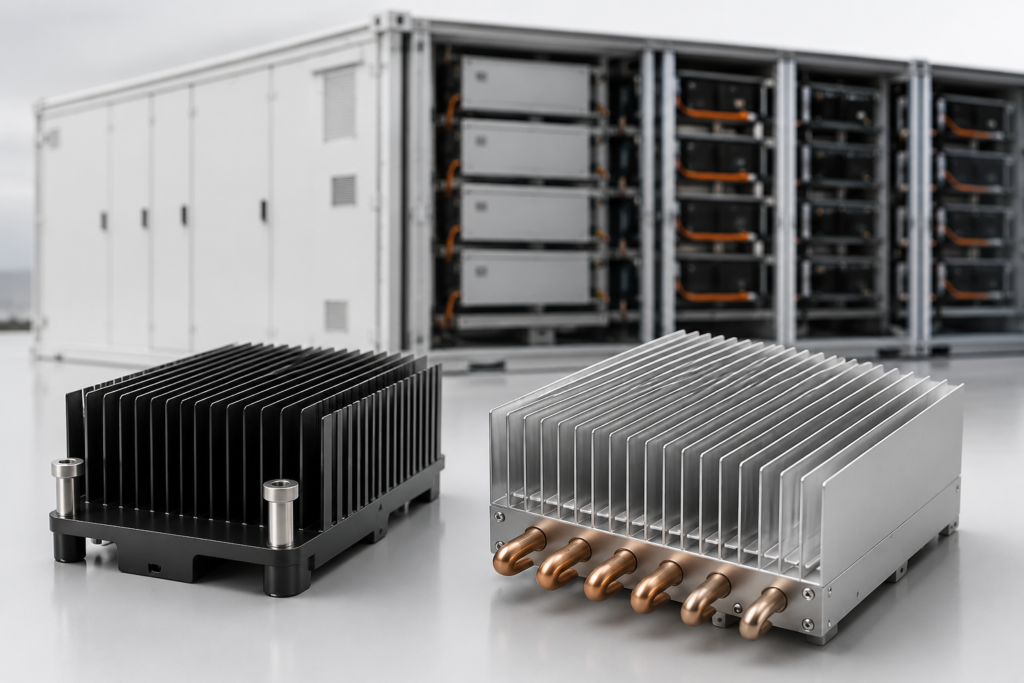
Why Is Thermal Management Such a Critical Aspect of Battery Storage?
Li-ion batteries are susceptible to changes in temperature. However, where the battery pack gets heated, there will be an increase in the amount of internal resistance, deterioration of the charging process, and even cases of thermal runaway.
Conversely, where there is cold weather, there is decreased charge efficiency and poor performance. Effective thermal management will see the battery cells operate at a temperature range, irrespective of whether it is cold or hot.
What Is The Purpose of Customized Heat Sinks In BESS Systems?
There is little in terms of pre-manufactured heat sink solutions that fit the unique geometry, air flow dynamics, or power density characteristics of battery rack systems. It is here that custom heat sinks come into play, as engineers are able to customize such factors as fin density, base dimensions, and surface areas based on the thermal profile of the battery itself.
The following are some of the benefits of using custom design against pre-fabricated ones:
- Heat sinks with fins are customized according to the size of the gap that exists inside the battery enclosure and the amount of airflow.
- Materials that are used for making heat sinks (aluminum extrusion, die cast, and skived fins) are customized according to the heat load and cost of the system.
- Heat sinks are customized according to the way they interface with the module housing.
How is Heat Sink Design Validation Performed in Energy Storage Applications?
Heat sink design doesn’t happen in one step. Rather, it is performed in an organized way, including thermal input design, CAD modeling, simulation, prototyping, and testing. Using simulation software allows designers to test how heat would flow in the pack during charge-discharge cycles without any physical samples, which allows them to detect hot spots prior to manufacturing a prototype.
Why is it important? The thing is that energy storage racks have a very specific environment with constrained airflow, variable ambient temperature, and densely arranged cells. Thus, what worked in an open environment might not work at all in a rack enclosure.
What are the Manufacturing Methods Used for BESS Heat Sinks?
There are many different types of fabrication methods that need to be considered depending on the particular storage application.
- The extrusion heat sink is an economical choice and can accommodate a high level of mass production.
- Die-cast heat sinks provide good geometry and a high level of productivity during mass manufacturing.
- Skived fins and heat pipes provide better thermal performance where limited space is available.
All of these choices will depend on the heat load, space, quantity, and budget for a particular storage system.
How Can Tailored Heat Sinks Lead to More Reliable Systems Over Time?
Each instance of operating outside the ideal temperature range speeds battery degradation. Appropriate design of cooling systems will reduce such instances and lead to extended cycle life. Additionally, it promotes uniform seasonal performance by designing a system that can operate in the extremes of hot summer and cold winter.
Additionally, there is an aspect of safety here, since efficient cooling minimizes the chances of developing local hot spots that may trigger further failure within highly integrated modules.
What Should an Engineer Seek in a Thermal Solutions Supplier?
It is not true that all suppliers possess the same level of engineering capabilities that can allow the process of developing the product from initial conceptualization to validated manufacturing.
An engineer should seek an experienced supplier that provides simulation capability internally, multiple forms of fabrication in the same place, and experience in harsh industries such as the automotive or telecommunication industry, instead of general electronics. The reason behind this requirement is that ESS and BESS systems may have the same thermal requirements.
Creating a Foundation That Makes a Battery Storage System Cooler and Safer
Thermal management is not merely an afterthought when it comes to the success of your battery storage system; it should be at the core of the design process.
At PT Heatsink, we draw on our collective experience spanning decades and a range of advanced capabilities in simulations and fabrication techniques to ensure that your battery storage system gets a proper thermal management foundation from the very beginning of the design process.
Reach out to us to get a custom solution for your next project.
FAQs:
In what way do engineers choose either an extrusion heat sink or a die-cast heat sink when designing a battery system?
It all depends on whether it is better to produce a large amount of simple components or less complex but more complicated components. The budgetary and timing considerations become quite important for this choice at the early stage of the project.
Is it possible to simulate battery hotspot locations before creating the first prototype?
Absolutely, using software such as Flotherm and Ansys, it is possible to simulate heat propagation through the battery under real-life charge cycles. However, without the prototype test, this is not enough, since simulations will lack some aspects of the problem.
Why do batteries need a special cooling system compared to open electronics?
Enclosed battery racks prevent heat dissipation and limit the possibilities of airflow. Thus, it is impossible to use the same approach that is applied for the open devices since cooling systems have to be adapted to the conditions of the cabinet.
Is there an impact of ambient temperature variation on the heat sink design selection of outdoor storage systems?
Of course, because the design should be able to deal with peak load conditions in summer and cold weather problems of charging. That is why some additional thermal margins are often provided just for such extreme seasonal cases.
What is the approximate period from the initial design input to the validated prototype of the heat sink?
This period varies from design to design and passes through the design itself, simulation, fabrication, and customer validation before entering small-quantity and mass production.