
“Thermal Management Challenges in AI Infrastructure and Heat Sink Innovations” represents the literal wall for cluster performance. We are well past standard server density. The International Energy Agency (IEA) expects global data centre electricity use, driven by AI, to double to 945 TWh by 2030 from 415 TWh in 2024. That is Japan’s annual usage. Generic cooling cannot handle this flux. Solving these Thermal Management Challenges effectively requires custom hardware and high-performance metal.
Why is the current AI boom breaking traditional cooling models?
For decades, data centres relied on the simple movement of air. You pushed cold air in the front and pulled hot air out the back. This worked for CPUs pulling. It does not work for an H100 or B200 GPU pulling 700 to 1,000 watts per chip. When you pack eight of these into a single chassis, the heat density becomes comparable to a nuclear reactor core. Air simply cannot carry away the calories fast enough. This leads to immediate thermal management issues where the silicon throttles its own clock speed to prevent a meltdown, effectively wasting the millions of dollars invested in the hardware.
What are the core thermal management challenges in electronics used for AI?
The primary hurdle is “Heat Flux.” It is not just about the total amount of heat, but how small the area is where that heat is generated. AI chips have massive die sizes, but the hottest spots are concentrated in the HBM (High Bandwidth Memory) stacks and the core logic.
- Micro-convection failures: Standard fan speeds cannot create enough static pressure to move air through the dense fin arrays required for these chips.
- Interface Resistance: Even the best thermal paste starts to fail when you are pushing this much energy through a microscopic gap.
- Local Hotspots: Uneven heat distribution across a GPU die causes localized expansion, which can lead to structural failure of the solder bumps over thousands of power cycles.
How do Thermal Management Challenges in AI Infrastructure and Heat Sink Innovations intersect in modern design?
Engineers are now forced to innovate at the material level to solve Thermal Management Challenges in AI Infrastructure and Heat Sink Innovations. We are seeing a massive shift toward two-phase cooling and hybrid designs. A simple block of aluminium is no longer an option for an AI rack.
Can vapour chambers replace traditional copper bases?
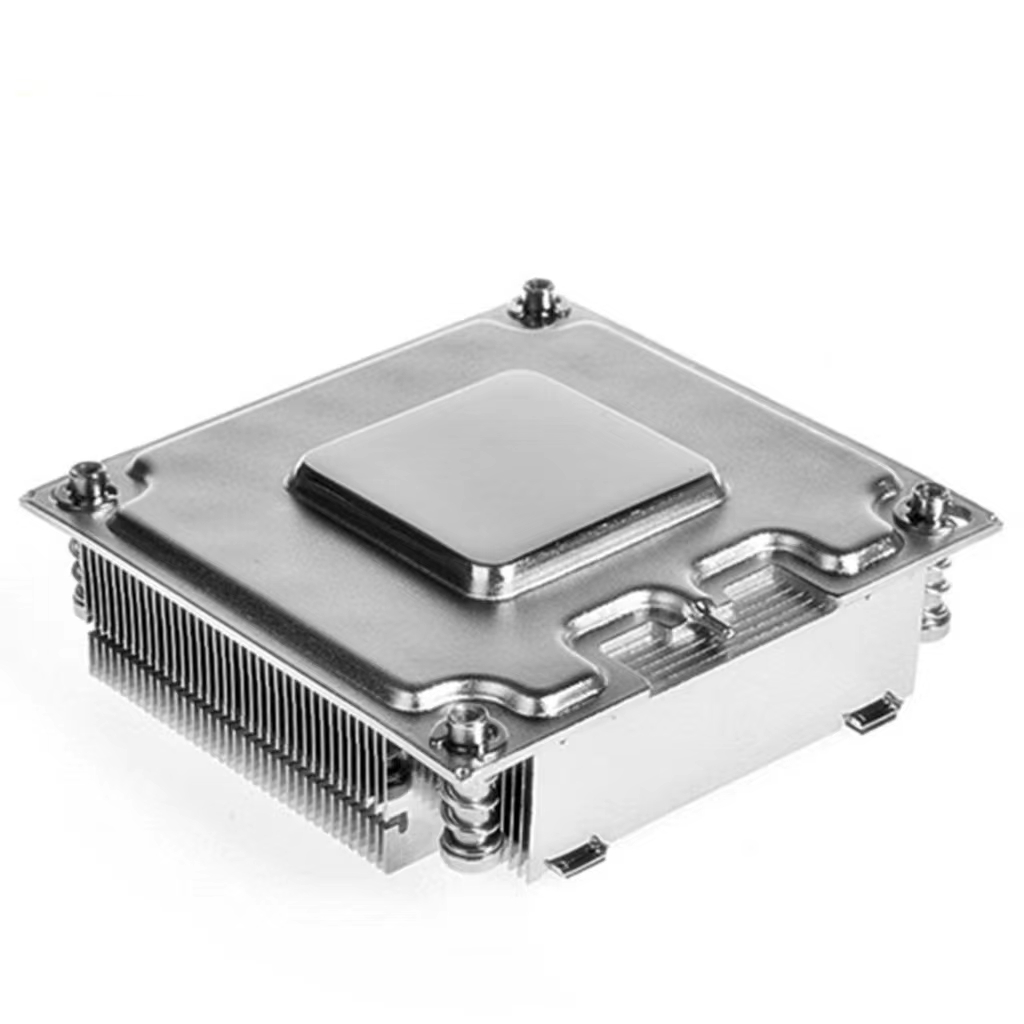
Vapour chambers are effectively flat heat pipes. They use a vacuum-sealed chamber with a small amount of liquid that evaporates at the heat source and condenses at the cooler edges. In AI infrastructure, these chambers are being integrated directly into the heat sink base. This allows for a much faster “spreading” of heat across the entire fin array. If the heat stays concentrated in the centre of the sink, the outer fins are essentially dead weight. Vapour chambers make every millimetre of the cooling surface active.
Why are thermal efficiency problems becoming more expensive?
When a data centre faces thermal efficiency problems, the cost isn’t just the electricity used for cooling. It is the “Performance-per-Watt” metric. If your cooling system is inefficient, you are spending more on the fans and the chillers than you are on the actual computation. In the AI world, compute is currency. Every degree of temperature reduction translates to a percentage increase in stable clock speed. Over a cluster of 10,000 GPUs, a 2% efficiency gain in thermal management can save millions in annual OpEx.
What are the biggest thermal management challenges in electronics for 2026?
As we look toward the end of the decade, the density of AI clusters is expected to triple. We are moving toward “Direct-to-Chip” liquid cooling, but heat sinks still play a vital role in the secondary cooling of VRMs (Voltage Regulator Modules) and networking components. The challenge is managing these secondary components, which often get “baked” by the radiant heat coming off the primary processors.
- Acoustic Limits: We cannot simply spin fans faster; the noise levels in data centres are reaching the point where they can damage hard drives through vibration.
- Supply chain volatility: Sourcing is hitting high-purity copper and sintered wick structures, making industrial-scale procurement a logistical hurdle.
- Volume wall: Standard rack dimensions are fixed while silicon footprints and power draws continue to swell.
How can innovation in heat sink geometry solve Thermal Management Challenges in AI Infrastructure?
Geometry is our primary lever. We are abandoning standard extruded sinks for skived and zippered fin arrays. Skiving allows us to shave fins thinner than traditional milling, packing more surface area into 1U or 2U heights. It is a direct response to rising flux. 3D vapor chambers take this further by merging the vacuum chamber into the fin structure. We are moving heat vertically. This bypasses the thermal resistance of solid metal entirely. It is a requirement for 700W+ chips.
What does the future of AI heat dissipation look like?
We are likely headed toward a “Total Thermal” approach. This means the server rack itself is designed as a single cooling unit rather than a collection of individual servers. We are seeing cold plates that utilize micro-channels smaller than a human hair to pump coolant directly over the silicon. However, even in these liquid-cooled systems, high-performance heat sinks are required for the “dry” side of the heat exchange.
PT Heatsink solves the thermal bottlenecks in high-density compute. We engineer customized vapor chambers and high-density fin stacks to handle the extreme heat flux of AI accelerators. Without precise cooling, silicon throttles, rendering your investment inefficient. We focus on physical reliability. Our designs prepare infrastructure for the projected 945 TWh energy demand of 2030. PT Heatsink ensures your hardware maintains peak clock speeds during heavy training runs. Performance is a thermal problem. We provide the hardware to solve it.
FAQ
Why is liquid cooling not the only solution for AI?
While liquid cooling is efficient, it introduces significant risk and complexity. Leaks can be catastrophic, and the infrastructure required (CDUs, manifolds, and specialized plumbing) is incredibly expensive to retrofit into existing data centres. Many operators prefer “Air-Assisted Liquid Cooling” or high-performance heat sink innovations because they offer a middle ground: the reliability of air with the performance of advanced thermal materials.
What is the difference between active and passive heat sinks in an AI context?
In an AI rack, “passive” sinks are actually part of an active system; they rely on the massive “jet-engine” fans at the back of the server chassis to move air through them. Truly passive cooling doesn’t exist in high-performance AI. The design of these sinks must be optimized for “pressure drop.” If a heat sink is too dense, the air won’t go through it; it will go around it, causing the chip to overheat.
How does “Thermal Throttling” affect AI training times?
When a GPU hits its thermal limit (usually around 85-90 degrees Celsius), it automatically lowers its voltage and frequency. This is a safety feature. However, in AI training, a single throttled node can slow down the entire cluster. Because the GPUs must stay in sync, the whole “job” runs at the speed of the hottest, slowest chip. This can turn a three-week training run into a four-week run, costing hundreds of thousands in extra electricity and lost time.
Are there new materials being used beyond copper and aluminium?
Yes, we are seeing the introduction of AlSiC (Aluminum Silicon Carbide) and graphite sheets. Graphite has incredible thermal conductivity in the X-Y plane, making it perfect for spreading heat away from hotspots very quickly. Some experimental designs even use synthetic diamond as a heat spreader, though the cost remains prohibitive for most commercial applications.
How does PT Heatsink test for long-term reliability?
Thermal management isn’t just about the first hour of operation; it’s about year five. We use accelerated life testing, including thermal cycling and vibration stress, to ensure that the vacuum seals in our vapour chambers and the bond lines in our fin stacks don’t degrade. In the high-vibration environment of a data centre, a single hairline crack in a cooling component can lead to a total system failure.