
The primary purpose of liquid cooling plate coating
Surface coating of liquid cooling plates primarily fulfills one or more of the following critical functional requirements:
Electrical Insulation:
This is the most common and critical purpose. Liquid cooling plates typically come into direct contact with high-power, high-voltage electronic components. Applying a highly insulating coating prevents the cooling plate itself from conducting electricity, thereby avoiding short-circuit incidents and ensuring electrical safety within the system.
Corrosion Resistance:
Coolant circulating continuously within channels may corrode metallic conduits (e.g., aluminium, copper). Coatings isolate the cooling plate substrate from direct coolant contact, preventing corrosion by-products from clogging micro-channels or contaminating the cooling system.
Enhanced Compatibility:
Certain coating materials offer superior compatibility with specific coolants, preventing adverse chemical reactions.
Wear Resistance and Protection:
Coatings provide a protective layer for the relatively soft aluminium surface of the cold plate, preventing scratches during installation, transportation, or operation.
Primary Coating Processes for Liquid-Cooled Plates
In liquid-cooled plate manufacturing, electrostatic powder coating is the most prevalent surface coating process. Additionally, liquid spraying and plasma spraying are employed for specialised applications.
Electrostatic Powder Coating
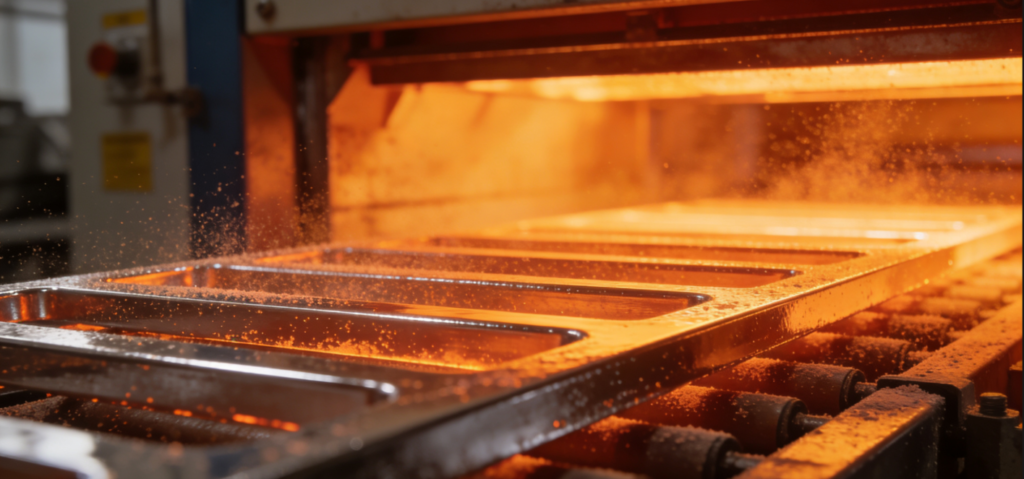
This is currently the most widely adopted and mature process within the liquid cooling plate industry.
Solid powder coating is conveyed through a powder supply system and delivered to the spray gun by compressed air.
A high-voltage electrostatic generator at the spray gun’s tip generates tens of thousands of volts, imparting a negative charge to the emitted powder particles. The grounded
(positively charged) liquid cooling plate serves as the anode.Under the influence of the electrostatic field, the negatively charged powder adheres uniformly to the surface of the liquid cooling plate. Subsequently, the workpiece is transferred to a curing oven where the powder melts, levels, and solidifies at high temperatures, forming a uniform and robust coating.
Advantages:
High efficiency: Powder can be recycled, with high transfer efficiency typically exceeding 95%.
Environmentally friendly: Contains no organic solvents, with zero VOC (volatile organic compound) emissions, meeting environmental requirements.
Superior coating quality: A thick, uniform coating free from sagging is achieved in a single application.
Superior Performance: The coating exhibits excellent mechanical strength, chemical resistance, and insulation properties.
Disadvantages:
Requires high-temperature curing (typically 160–200°C), unsuitable for finished cold plates with heat-sensitive components or substrates with poor temperature resistance.
Difficult to ensure uniform powder application on workpieces with deep holes or complex internal cavities.
Liquid Spraying
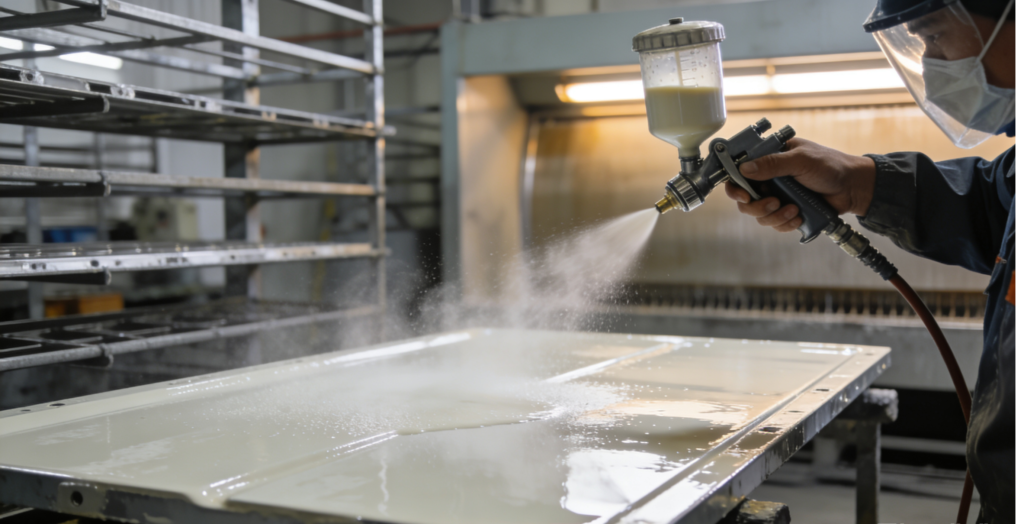
Application of traditional liquid coatings (e.g., epoxy, polyurethane) via spraying.
The liquid coating is diluted to an appropriate viscosity, atomised via a spray gun onto the workpiece surface, then cured through natural air-drying or low-temperature baking.
Advantages:
Low-temperature or ambient curing: Suitable for components intolerant of high temperatures.
Thin coating: Enables formation of extremely thin insulation layers (e.g., 10–30μm), minimising impact on thermal dissipation.
Disadvantages:
Poor environmental credentials: Contains solvents, posing risks of VOC emissions and fire hazards.
Lower efficiency: Coating wastage occurs, requiring multiple applications to achieve sufficient thickness, with susceptibility to defects such as sagging and orange peel.
Coating performance: At equivalent thickness, typically inferior to powder coatings in terms of density, abrasion resistance, and dielectric strength.
Plasma Spraying
This thermal spraying technique is employed to produce specialised functional coatings.
Ceramic or other high-melting-point material powders are instantaneously heated to a molten or semi-molten state via a plasma arc (ultra-high-temperature ionised gas) and then rapidly projected onto a liquid-cooled substrate surface to form the coating.
Application Scenarios: Primarily employed in extreme environments demanding exceptionally high dielectric strength,outstanding corrosion resistance, or specialised thermal conductivity/insulation requirements. This process is predominantly utilised in aerospace or certain high-power power electronics sectors, potentially involving the application of ceramic coatings such as aluminium oxide (Al ₂ O₃ ).
Advantages: Exceptionally superior coating properties, including high-temperature resistance, wear resistance, and high insulation.
Disadvantages: Expensive equipment, complex process, high cost, thicker coatings with potential porosity.
Commonly Used Coating Types
Epoxy Resin Powder: The most widely used type. Offers outstanding electrical insulation, chemical corrosion resistance, adhesion, and mechanical strength. The preferred choice for insulating spray coatings on liquid-cooled plates.
Polyester Resin Powder: Offers superior outdoor weather resistance compared to epoxy, though slightly inferior electrical insulation and chemical resistance. Suitable for applications requiring UV resistance in outdoor environments.
Epoxy-Polyester Hybrid Powder: Combines the advantages of both epoxy and polyester, offering balanced performance and extensive applicability.
Ceramic-based coatings: Primarily employed in plasma spraying, delivering top-tier performance.
Electrostatic Powder Coating Process Flow
Pre-treatment:
Thoroughly clean and degrease the liquid cooling plate to remove oil residues.
Masking:
Areas requiring protection from coating (e.g.,threaded holes, mounting surfaces, interfaces) are pre-covered using jigs or high-temperature masking tape.
Surface roughening:
Employ sandblasting and grinding to increase surface roughness, providing excellent mechanical anchor points for coating adhesion.
Spraying:
Apply the coating uniformly under the precise control of robotic systems or automated spray lines. Parameters such as power output, powder feed rate, spray distance, and movement speed must be meticulously regulated.
Curing:
Transfer coated components into curing ovens where powder melts, cross-links, and solidifies at preset temperatures and durations.
Cooling and Inspection:
After exiting the furnace, components undergo natural or forced cooling.
Visual inspection: Check for defects such as missed spraying, orange peel, particles, or bubbles.
Thickness inspection: Measure coating thickness using a film thickness gauge to ensure compliance with design specifications. Double-coating is required for thicker layers.
Insulation Withstand Voltage Test: Apply high voltage (e.g., AC 1500V or DC 3000V for 60 seconds) between the coating surface and substrate using a withstand voltage tester. Record current and insulation resistance to detect breakdown, ensuring insulation reliability.
For liquid-cooled plate surface coating, electrostatic powder spraying has become the industry standard choice due to its outstanding balance of performance, efficiency, and environmental friendliness. Rigorous pre-treatment and 100%insulation withstand voltage testing are critical to ensuring the long-term reliable operation of liquid-cooled plates.